




If you are looking for a brazing materials factory, start with the joint you need to make, not with a price list. A useful supplier can name a filler metal and, where the process requires it, a flux that fits your base metals and heating method. It should also support that recommendation with composition data, batch documents, and samples you can trial on your own parts.
Unit price and a long catalog will not tell you whether a lot will wet consistently, or whether the next shipment will match the first. The notes below use the public English catalog of Zhejiang Xinrui Brazing Technology Co., Ltd., known as XINRUI, as one example of how to read a product range. A catalog is not a substitute for document review and trial brazing.
Know the process and the materials you are buying
Brazing, soldering, and welding are easy to mix up in a purchasing brief, and the mix-up leads to the wrong alloy family. The American Welding Society's Brazing Handbook describes brazing as a group of joining processes in which the workpieces and a brazing filler metal are heated to the brazing temperature without melting the base metals, and the filler metal is drawn between closely fitted joint surfaces by capillary action. The filler metal must have a liquidus above 450 degrees Celsius, about 840 degrees Fahrenheit. Soldering uses the same capillary idea with a filler metal that melts at or below that temperature. Fusion welding, by contrast, melts the base metals themselves; solid-state welding processes do not.
A brazing filler metal is the alloy that melts, wets the joint, and solidifies to form the bond. Composition ranges are classified in standards such as AWS A5.8M/A5.8 and ISO 17672.
A brazing flux removes or prevents surface oxides so the filler metal can wet. Fluxes are classified in AWS A5.31M/A5.31. Flux is not always required. Clean copper-to-copper joints are often brazed with phosphorus-copper filler metals that need no separate flux. Vacuum and controlled-atmosphere brazing may also run without flux. Flame and air-furnace work on aluminum, brass, or steel usually needs a flux matched to the alloy and temperature range.
Your inquiry should name the filler metal, the flux or atmosphere, and the product form as separate items.
Match filler metals and fluxes to the metals in the joint
The right factory can discuss your assembly, not only a stock grade. Base metals, joint clearance, heating method, and service conditions all change the recommendation. An Al-Si filler metal that works on a common heat-exchanger alloy may wet poorly on a higher-magnesium grade. A copper-to-aluminum joint is not a place to force a standard aluminum or copper alloy and hope it holds.
The table below is a starting map for inquiry, not a substitution chart. Confirm every row against the factory's data sheet and a trial on your parts.
| Joint or base metals | Filler-metal family often discussed | Flux or atmosphere notes | What to confirm with the factory |
|---|---|---|---|
| Aluminum to aluminum | Aluminum-silicon filler metals, often in the 4045 or 4047 type range | Potassium fluoroaluminate fluxes are common in controlled processes. Higher-activity halide fluxes are sometimes used in flame work. Residue rules differ. | Part alloy and temper, melt range, recommended clearance, and whether residue must be removed |
| Copper to aluminum | A dedicated copper-aluminum brazing material, not a generic Al-Si or copper alloy | A matched flux, flux-cored form, or paste is often part of the system | Joint design, corrosion risk in service, and a trial on the actual parts |
| Copper to copper | Phosphorus-copper filler metals are widely used | Often self-fluxing on clean copper. Flux may still be needed on oxidized surfaces or when brass is involved. | Surface condition, leak or pressure test, and whether the phosphorus level is acceptable |
| Copper or brass to steel | Silver-based filler metals are a frequent choice | An active flux is typically required in air. Cadmium-free grades are the usual purchasing baseline. | Strength need, maximum assembly temperature, and flux residue policy |
| Steel to steel, or other copper-family joints | Copper-based filler metals, including copper-zinc and related alloys | Flux is commonly required in air. Atmosphere or vacuum practice is different. | Melting range versus heat-input limits, and which copper family is actually specified |
Check that the catalog separates these families instead of offering one "universal" wire. On the XINRUI site, aluminum-to-aluminum and copper-to-aluminum filler metals, aluminum fluxes and aluminum brazing paste, and silver-based and copper-based filler metals are listed in separate categories. You still need a written recommendation for your metals.
If the work is a heat exchanger, an HVAC assembly, or an automotive thermal component, use the application page as background, then bring your drawings to the inquiry. See heat exchanger brazing, HVAC and refrigeration, and automotive applications. Application copy is not a process specification.
Pick a product form that fits how you braze
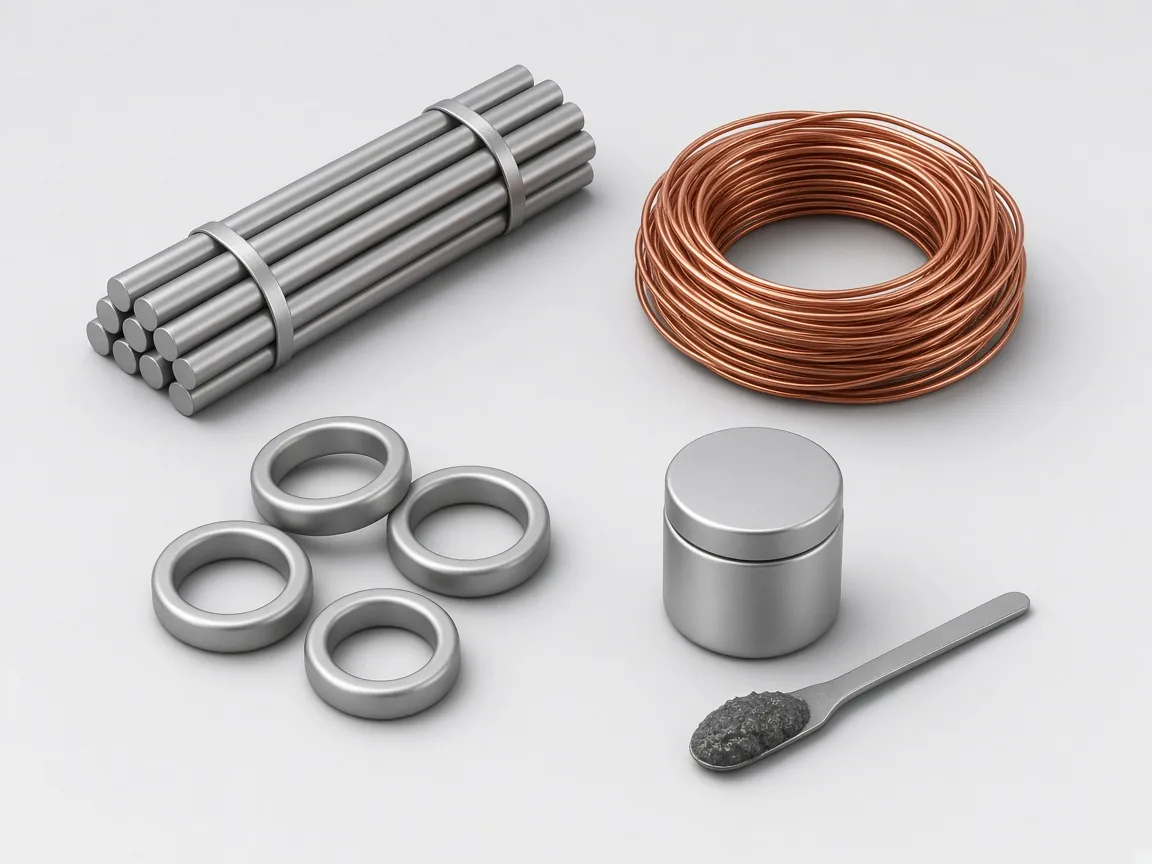
The same nominal alloy can arrive as rod, wire, preformed ring, paste, flux-cored wire, or a flux-coated ring. Form affects dose control, labor, automation, and residue.
- Rod and wire suit manual torch work and many automatic wire feeders. Ask for diameter, spool or straight length, and tolerance, not only the alloy name.
- Preformed rings place a measured amount of filler at the joint before heating. They help repeatability when the ring matches the land or groove.
- Paste combines filler-metal powder with a binder, and often with flux, so it can be dispensed. Shelf life, viscosity, and storage matter as much as metal content. XINRUI lists an aluminum brazing paste in its flux category, so check whether a paste is filler, flux, or both.
- Flux-cored wire carries flux inside the filler metal and can skip a separate fluxing step in some flame work. The core chemistry still has to match the base metal. Use the aluminum flux-cored brazing material page as an example of the form, then ask for the data sheet of the grade you would trial.
- Flux-coated rings combine a preform with a flux coating, as on the flux-coated brazing ring page. Confirm coating type, adhesion, and storage.
- Separate flux may be a powder, a paste, or a vaporized gas flux such as trimethyl borate used with a flux generator. Fluoroaluminate flux for aluminum brazing and the FB2 series halide aluminum flux are different chemistries. Do not treat them as interchangeable.
If you run, or plan to run, a turntable, conveyor, or robotic flame cell, say so in the inquiry. Some factories also build flame brazing equipment. That can put material and heat source in one discussion, but you should still qualify the alloy and the machine separately.
Judge the factory by documents, samples, and consistency
Ask for items you can file and compare. Treat missing paperwork as a risk.
Composition and classification. Request a data sheet that lists chemical composition, solidus and liquidus, recommended brazing temperature range, and available forms. Ask whether the grade is classified to AWS A5.8, ISO 17672, or another named standard, or whether it is only a house designation. A house grade can be acceptable if the composition is published and held lot to lot.
Batch evidence. For each trial lot, ask for a certificate of analysis or inspection certificate, a safety data sheet, and packing details. If you need traceability, say how the batch number must appear on the label, coil, or pail. Do not assume a website quality badge means a certificate will arrive with the goods.
Dimensional and process checks. Measure wire or rod diameter, ring dimensions, and paste workability against the data sheet. Then trial the material on your parts, with your clearance, cleanliness, and heating cycle. A laboratory coupon is useful. It is not the same as a production joint.
Quality-system claims. Many factories publish ISO or automotive quality-system marks. Request the current certificate and check the legal name, address, expiry date, and whether brazing materials are in scope. If the scope covers only equipment, or only one site, that matters.
Change control and packaging. Paste and flux are sensitive to moisture, temperature, and age. Ask about shelf life, storage, and what happens when a formula or raw-material source changes. For export shipments, ask who prepares the commercial documents and how hazardous-material rules are handled when they apply.
A single good sample is not a production approval. Agree on a retained sample, a retest trigger, and what happens if a later lot falls outside the agreed composition or dimension range.
What to include in a first inquiry
Send the following in one note, even if some items are approximate.
- Base metals and, if known, alloy grades and tempers on both sides of the joint.
- Joint type, clearance or fit-up, and a sketch or photo of the assembly.
- Heating method: torch, induction, furnace, or another process, plus any atmosphere or vacuum practice.
- Service conditions: refrigerant, coolant, pressure, temperature, vibration, or outdoor exposure, as they apply.
- The product form you want to trial, or a note that you want the factory to propose a form.
- Any required standard classification, forbidden elements such as cadmium, and residue or cleaning limits.
- The documents you need with samples and with production lots: data sheet, SDS, and batch certificate at a minimum.
- Trial quantity, target packing, destination, and the incoming-inspection steps you will run.
- Whether you also need process advice or equipment, so the factory can route the inquiry to the right person.
XINRUI's English contact page accepts technical inquiries of this kind. Use it, or your usual purchasing channel, but keep the same detail in writing. A switchboard number and a Shengzhou, Zhejiang address appear on that page. Confirm the packing site and shipping point before you place a production order.
How to read the XINRUI product range
XINRUI is Zhejiang Xinrui Brazing Technology Co., Ltd., based in Shengzhou, Zhejiang. The company is listed on China's National Equities Exchange and Quotations under stock code 834975. Its public English site, brazingmaterials.com, presents filler metals, fluxes, brazing tools, and flame brazing equipment. The about page and the product catalog show how that range is organized.
The published English categories include:
- Aluminum-silicon solid filler metals, including 4047-type wire, strip, and ring forms on the aluminum-silicon alloy filler metal page
- Aluminum flux-cored material and a copper-to-aluminum brazing material
- Fluoroaluminate and halide aluminum fluxes, plus aluminum brazing paste
- Silver-based and copper-based filler metals, flux-coated rings, and a copper-silver flux paste
- Trimethyl borate flux, grouped on the site with silver and copper materials because it is used in copper-family flame work
- Automated and manual flame equipment, and torch-side tools
That is a broad catalog for one factory conversation. It does not prove that a given grade will meet your drawing, or that a certificate will match the lot you receive. Those points belong in the inquiry and the trial plan.
If XINRUI, or another factory, is on your shortlist, ask for the data sheet and a batch certificate for the grade you intend to trial, then braze your own parts before you fix a production price. The contact page is the public route for that request.
Frequently asked questions
What should I expect a brazing materials factory to supply?
At minimum, a clearly specified filler metal in a form you can use, and a flux or a documented atmosphere practice when the process needs one. Many factories also supply preforms, pastes, and application advice. Some, including the XINRUI catalog, also list equipment. Equipment is optional. Material identity and documents are not.
Do all brazing jobs need flux?
No. Phosphorus-copper filler metals are often used without flux on clean copper-to-copper joints. Vacuum and many controlled-atmosphere processes also run without flux. Aluminum flame brazing and most silver brazing in air do need a flux chosen for the alloy and the temperature range. If someone says every joint uses the same flux, ask for the process basis.
How do I compare two factories that offer similar alloys?
Compare published composition, melting range, form and tolerance, batch documents, shelf-life rules, and the results of a trial on your parts. Then compare commercial terms. Two wires with the same family name can still differ in impurity limits, dimensional control, or flux core.
What is the difference between a house grade and a standard classification?
A standard classification, such as a grade under AWS A5.8 or ISO 17672, tells you the composition range and the naming system in use. A house grade is the factory's own name. It can be a solid production choice if the composition, melt range, and lot certificates are clear. It becomes a problem when the name is all you receive.
What belongs in a first quote request?
Your base metals, joint and heating method, service conditions, the form you want to trial, any required standards or restricted elements, the documents you need, and the trial quantity. If you omit the joint and the process, you will often receive a generic catalog price that you cannot use to qualify the factory.