




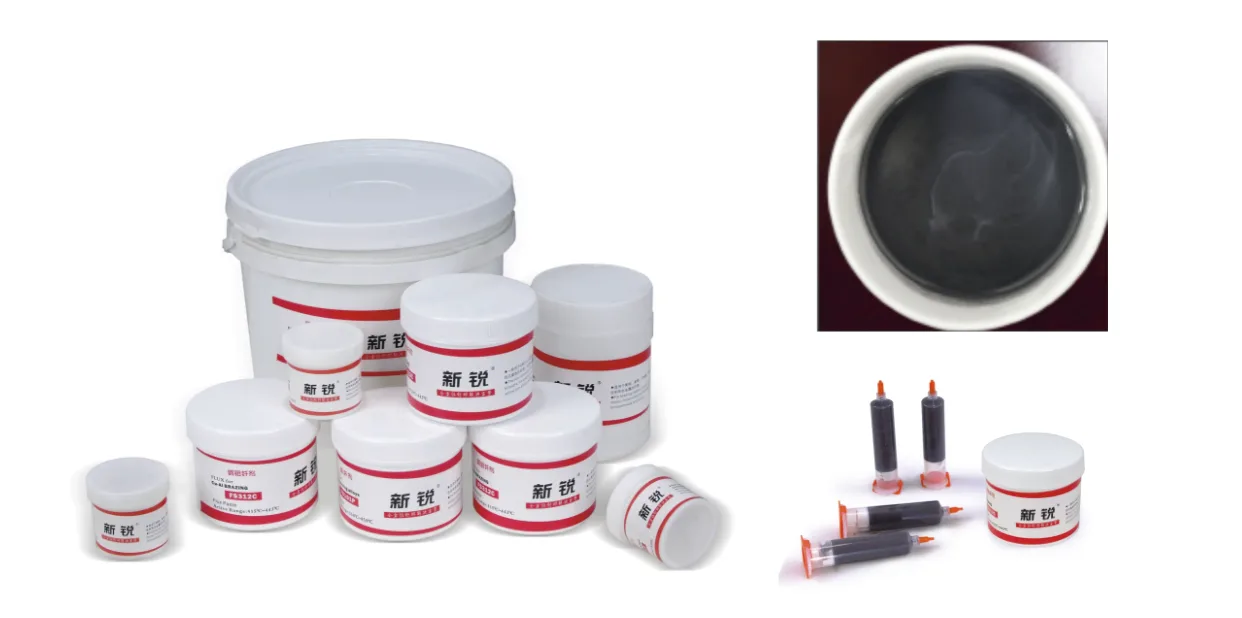
Aluminum brazing paste BA4047-K or BA4045-K is a grey paste of aluminum-silicon powder, noncorrosive flux and organic binder. It is brushed onto aluminum parts and is used for furnace, flame and induction brazing, especially on complex, irregular or large braze areas. Request the datasheet for metal grade, viscosity and packing.
Aluminum brazing paste BA4047-K or BA4045-K is a grey paste made of aluminum-silicon metal powder, a noncorrosive flux and an organic binder. It is brushed onto the aluminum alloy surface and is suitable for furnace brazing, flame brazing and induction brazing. Its main advantage, as already stated in the catalog, is on workpieces with a complex braze surface, an irregular shape, or a large brazing area.
Where a catalog grade, diameter, packing or process window is not listed on this page, it can be manufactured or selected to order. Please contact XINRUI and request the current datasheet for the grade you will trial.
Standards and filler-metal families
The metal powder in these pastes belongs to the aluminum-silicon family classified in AWS A5.8/A5.8M and ISO 17672. A 4047-type alloy is the near-eutectic Al-Si filler commonly identified as AWS BAlSi-4 and ISO Al 112, with a typical silicon range of 11–13% and a published melting range of about 577–582 °C (solidus to liquidus). A 4045-type alloy is a related Al-Si filler (often compared with AWS BAlSi-5) with a slightly wider melting range. The public figures describe the metal powder, not automatically the paste as applied; the binder and flux change how the product is handled. Confirm the designation, metal loading and flux type on the datasheet for BA4047-K or BA4045-K.
Flux type and residue
This paste is specified with a noncorrosive flux. In aluminum furnace and controlled-atmosphere practice, that usually means a potassium fluoroaluminate type flux, whose residue is often left in place after brazing when the process allows it. That is a different chemistry from the water-washable FB2 halide aluminum flux. If your specification requires a washed joint or a halide flux for higher-magnesium alloys, say so in the inquiry. See also the fluoroaluminate flux page.
Base metals and process
The paste is for aluminum alloy assemblies. Typical uses include complex fittings, irregular interfaces and large areas that are hard to feed with wire or a preform alone. Heating methods listed in the catalog are furnace, flame and induction. Joint clearance, preheat and peak temperature must stay within the window of the Al-Si alloy and the flux; for 4047-type metal, published brazing ranges are often about 582–604 °C, but the paste datasheet and a trial on your alloy temper are the controlling documents. Higher-magnesium base metals may need a different flux system.
Forms and packing
The product is supplied as a brushable paste. Jar or cartridge size, viscosity, metal-to-flux ratio and shelf life are not listed here and can be confirmed or adjusted on request. For wire, strip or rings of the same alloy family, see aluminum-silicon alloy filler metal.
Applications
Typical uses are aluminum joints in heat exchangers, HVAC and refrigeration fittings, and automotive thermal components where a paste deposit is easier to place than a preform.
Frequently asked questions
What do BA4047-K and BA4045-K refer to?
They are the catalog designations already used on this page for aluminum-silicon paste grades. 4047-type metal is a high-silicon Al-Si filler (typically 11–13% Si, AWS BAlSi-4 / ISO Al 112). 4045-type metal is a closely related Al-Si filler often used as cladding or a slightly wider-melting paste. Ask for the datasheet of the grade you will trial.
Is the flux in this paste the same as FB2 halide flux?
No. This paste is described as using a noncorrosive flux with an organic binder, which is the family usually associated with potassium fluoroaluminate furnace or controlled-atmosphere work. FB2 is a chloride-based halide flux whose residue is washed off with water. Do not treat them as interchangeable.
How is the paste applied?
The catalog describes brushing it onto the aluminum surface. It is intended for workpieces with complex, irregular or large braze areas, and for furnace, flame or induction heating. Dispensing grade, viscosity and shelf life should be taken from the datasheet.