



Open a flux cupboard in an aluminum brazing shop and you will usually find two white powders or pastes that look almost identical. One is a fluoroaluminate flux. The other is a halide flux, XINRUI’s FB2 series. Both are made for aluminum. Both work with the same 4047-type filler. And they are not interchangeable. Pick the wrong one and the joint may still look fine on the day — then fail in the field, or leave a line washing residue it never planned to wash. This article explains what each flux is, where each one belongs, and the five questions that settle the choice.
First, what the flux is actually doing
Aluminum covers itself in a tough oxide layer the moment it meets air, and filler metal will not wet an oxidized surface. The flux’s job is to break that oxide down at brazing temperature so the filler can spread and be drawn into the joint by capillary action. That is the whole point of flux, and it is also why the flux has to melt before the filler does: it has to clean the joint first. The catalog numbers show how that works in practice. XINRUI’s fluoroaluminate flux melts at 562–572 °C, just below the 4047 filler range of about 577–582 °C, so it is active and cleaning before the filler starts to flow. If the flux cannot do that job on your alloy, with your heating method, nothing else about it matters. Our aluminum-silicon alloy filler metal 4047 (about 11–13% silicon, AWS BAlSi-4 / ISO Al 112) is the usual partner for both fluxes in this article, and our guide on how to choose a brazing materials factory covers the wider questions — filler, flux and form as separate items, and what to ask for in a first inquiry.
Fluoroaluminate flux: the furnace-friendly one
Fluoroaluminate flux for aluminum brazing is aluminium potassium fluoride, a white crystal powder with an average particle size of 2–50 micron. Its principal component is the low-eutectic KF-AlF3 system. When it melts it is clear and transparent, with high activity at high temperature, and it breaks the oxide film on aluminum and copper so the filler spreads and wets. It is used for aluminum-to-aluminum, aluminum alloy and aluminum-to-stainless brazing, and the catalog lists automobile air conditioning, aluminum evaporators and radiators, electric heating appliances and aluminum structural parts among its uses.
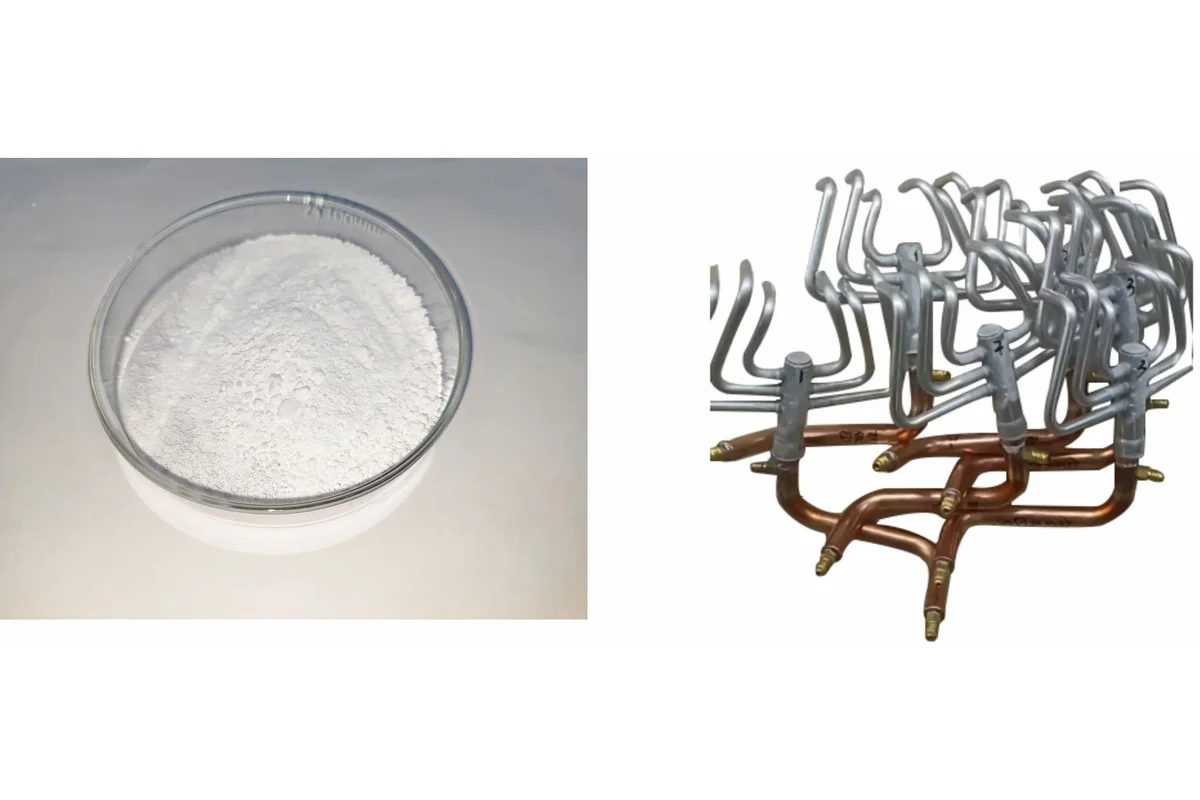
What makes fluoroaluminate the default choice on many lines is what happens after the joint cools. The residue is glassy, insoluble in water, does not absorb moisture, and is noncorrosive. Under nitrogen protection especially, little flux is needed and the joint need not be cleaned after brazing. That is why this family is so often used in furnace or controlled-atmosphere brazing, and why it suits the heat exchanger lines that run all-aluminum cores through a furnace and cannot afford a wash step after every part. It is supplied as a powder, packed in a plastic bag in a paper drum. The trade-off is activity: it is a lower-activity, noncorrosive family, and on some higher-magnesium alloys in open flame work it may not clean the joint as aggressively as a halide flux will.
Halide flux (FB2): the high-activity flame flux
The FB2 series halide aluminum brazing flux is a different chemistry. Its main matrix is NaCl, KCl and LiCl, with fluoride, a surfactant and an organic carrier added. It is supplied as a white paste or a white powder, and it is used with aluminum-silicon filler metals — 4047 and similar grades — for flame brazing and high-frequency (induction) brazing of aluminum alloys. Where fluoroaluminate is the quiet, leave-it-in-place flux, FB2 is the active one: high flux activity that can braze a wide range of aluminum alloy grades, and is especially suitable for higher-magnesium base metals such as 6061, 6063 and K70, which are often difficult for lower-activity noncorrosive fluxes in flame work.
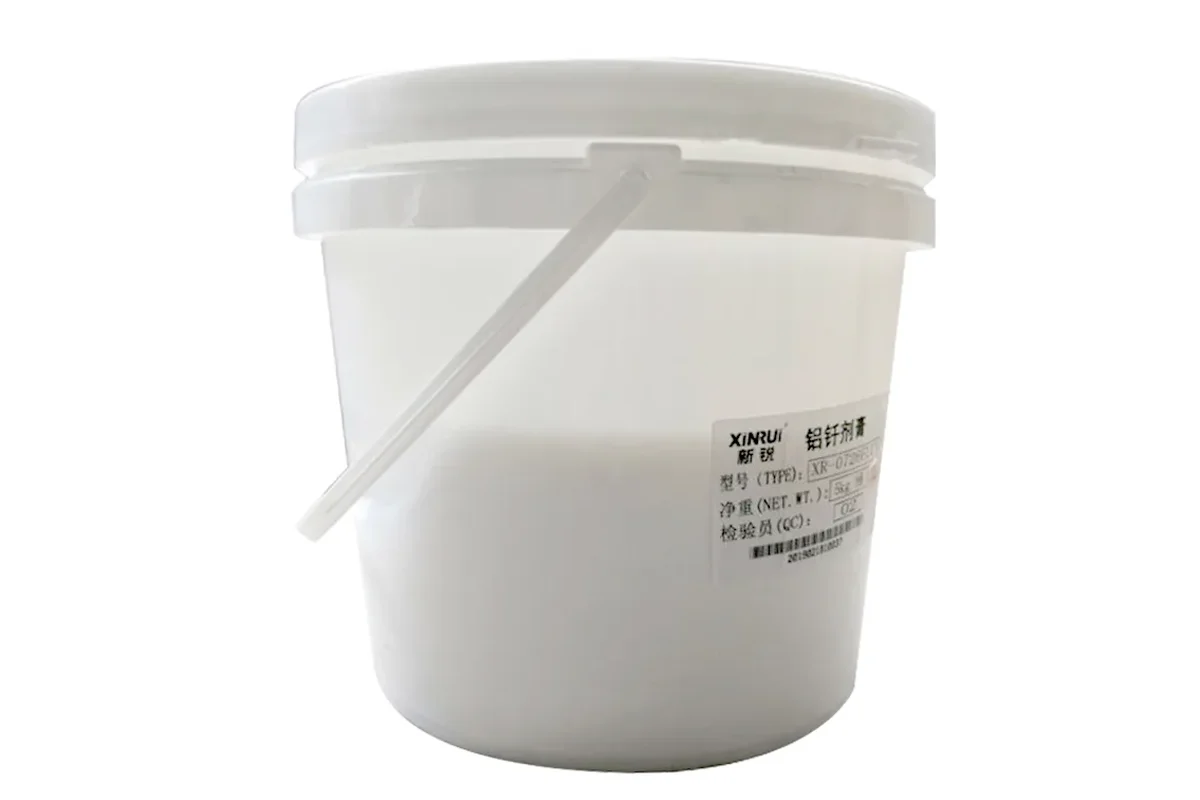
The price of that activity is a wash step. Halide residues are generally corrosive if left on the part, so the catalog specifies a water wash after brazing — and the residue is designed to come off easily with water. The joint can be inspected visually, which the catalog calls out as a practical advantage. FB2 is a flux for air processes: flame and induction brazing of pipelines, for example aluminum tube to aluminum tube, in refrigeration air conditioning, automobile air conditioning and similar systems, including HVAC and refrigeration pipework. It is not a CAB tunnel flux. So the honest way to think about FB2 is this: it buys you activity and alloy range, and it charges you a wash step and a visual inspection. If your line already washes parts, that is a small charge. If it does not, FB2 means adding a step you did not have.
Fluoroaluminate vs halide at a glance
| Fluoroaluminate flux | Halide flux (FB2 series) | |
|---|---|---|
| Chemistry | Aluminium potassium fluoride, KF-AlF3 low eutectic | NaCl / KCl / LiCl matrix, with fluoride, surfactant and organic carrier |
| Form | White crystal powder, 2–50 micron average particle size | White paste or white powder |
| Melting behaviour | Melts at 562–572 °C, clear and transparent when molten | High activity at brazing temperature, for flame and induction work |
| Heating | Furnace and controlled-atmosphere brazing in particular; also flame and induction | Flame and high-frequency (induction) brazing in air; not a CAB tunnel flux |
| Alloy range | Aluminum, aluminum alloy, aluminum-to-stainless | Wide range, especially higher-magnesium grades such as 6061, 6063 and K70 |
| Residue | Glassy, insoluble in water, no moisture absorption, noncorrosive; often no cleaning needed, especially under nitrogen | Corrosive if left on the part; wash with water after brazing, joint inspected visually |
| Typical use | Auto air conditioning, aluminum evaporators and radiators, electric heating appliances, structural parts | Aluminum tube joints in HVAC and refrigeration, auto air conditioning, heat exchanger pipework |
The third form: brazing paste
There is a third option that does not fit neatly into either column. Aluminum brazing paste (BA4047-K and BA4045-K) is a grey paste made of aluminum-silicon metal powder, a noncorrosive flux and an organic binder. It is brushed onto the aluminum alloy surface and is suitable for furnace, flame and induction brazing. Its main advantage, as the catalog puts it, is on workpieces with a complex braze surface, an irregular shape, or a large brazing area — places where powder is hard to place and wire is hard to feed. Paste is not a replacement for choosing between fluoroaluminate and halide; it is a different way of delivering filler and flux together, and it belongs in the same conversation when the joint geometry is the hard part.
Five questions that settle the choice
Between fluoroaluminate and FB2, the choice is rarely about which flux is “better”. It is about which one fits the line you already have. Work through these five questions with your own process in mind:
- How do you heat the joint? Furnace or controlled-atmosphere brazing points toward fluoroaluminate; open flame or induction work in air is where FB2 is designed to work. Do not use FB2 as a CAB tunnel flux.
- What alloy are you brazing? Tell the supplier the alloy and the temper. Higher-magnesium grades such as 6061, 6063 and K70 are the classic case for FB2’s higher activity; standard aluminum and aluminum alloys are the home ground for fluoroaluminate.
- Can you wash the parts? If there is no wash step and no appetite for adding one, a flux whose residue can stay in place has a real advantage. If washing is already part of the line, FB2’s wash requirement costs little.
- Powder, paste, or a third form? Powder suits dipping and furnace lines; paste suits brushing onto a joint; and where the surface is complex or the area large, the BA4047-K / BA4045-K paste may be the simpler answer than either flux alone.
- What does the trial show? Ask for samples and the current datasheet for the grade you will trial, then braze your own production parts — not coupons alone — and check the joints for fill, appearance and leak-tightness. XINRUI offers free samples, trial brazing, training and on-site support, with 24/7 technical support, and its about page lists the certifications behind it: IATF 16949, ISO 9001, ISO 14001 and ISO 45001, with RoHS-compliant full-process management.
Do not substitute one flux for the other without a process review — the catalog says so plainly, and it is good advice. The filler and the flux should be specified together, because a filler that flows beautifully with one flux can leave a poor joint with the other. Send the supplier the alloy, the heating method, whether you can wash, and a joint drawing, and the recommendation follows quickly from those four things.
FAQ for aluminum brazing buyers
Can I use FB2 halide flux instead of fluoroaluminate flux?
Not without a process review. FB2 is a halide flux based on NaCl, KCl and LiCl, with added fluoride, surfactant and an organic carrier; fluoroaluminate is aluminium potassium fluoride. They are different chemistries with different residue behaviour, and the catalog warns against substituting one for the other without a review.
Does fluoroaluminate flux residue need to be cleaned off?
Often not. The residue is glassy, insoluble in water, does not absorb moisture and is noncorrosive, and under nitrogen protection especially, little flux is used and the joint need not be cleaned after brazing.
Must FB2 residue be washed off?
Yes. Halide residues are generally corrosive if left on the part, so the catalog specifies a water wash after brazing. The residue is designed to come off easily with water, and the joint can then be inspected visually.
Which flux is better for 6061 and 6063 aluminum?
FB2 is the catalog’s recommendation for higher-magnesium base metals such as 6061, 6063 and K70, because its high activity can braze a wide range of aluminum alloy grades that lower-activity noncorrosive fluxes struggle with in flame work. Confirm the alloy temper and a trial joint before production.
When is brazing paste a better choice than flux powder?
When the workpiece has a complex braze surface, an irregular shape, or a large brazing area. Aluminum brazing paste (BA4047-K and BA4045-K) is a grey paste of aluminum-silicon powder, noncorrosive flux and organic binder that is brushed onto the surface, and it suits furnace, flame and induction brazing.
Fluoroaluminate and halide fluxes both braze aluminum, but they ask different things of your line: one asks for a furnace and leaves a residue you can often leave alone; the other asks for a flame, a wash step, and rewards you with activity on harder alloys. If you send XINRUI the alloy, the heating method, whether you can wash, and a joint drawing, the factory can recommend a flux and a filler — and supply samples to trial on your own parts. See the fluoroaluminate flux and FB2 halide flux pages, or contact XINRUI to start a trial.