




Copper-based filler metals at XINRUI include copper-zinc, phosphorus-copper and silver-bearing phosphorus-copper alloys for flame, induction and furnace brazing of copper and copper alloys. Phosphorus-copper grades are intended for copper-to-copper work and should not be used on steel or nickel. Request the datasheet for the grade you will trial.
Copper-based brazing filler metals are used when the joint is mainly copper or a copper alloy, and when a silver-based filler is not required. XINRUI groups them into four families already used in this catalog: high-copper alloys, copper-zinc alloys, copper-phosphorus alloys, and special copper alloys. The photographs and tables below are the existing catalog presentation for phos-copper and phos-copper-silver grades.
Where a catalog grade, diameter, packing or process window is not listed on this page, it can be manufactured or selected to order. Please contact XINRUI and request the current datasheet for the grade you will trial.
Standards and designations
These families are classified in AWS A5.8/A5.8M (Specification for Filler Metals for Brazing and Braze Welding) and in ISO 17672 (Brazing — Filler metals). Common AWS classes include the BCuP (phosphorus-copper) series, such as BCuP-2, BCuP-3 and BCuP-5. The ISO 17672 CuP series covers the same idea. Ask for the AWS or ISO designation that applies to the specific XINRUI grade you will trial; do not assume a catalog photograph is already certified to a named class until the datasheet says so.
Typical composition and melting behavior
Phosphorus-copper fillers are based on the copper-phosphorus system. Phosphorus lowers the melting range and improves fluidity, and it also gives these alloys a self-fluxing action on clean copper. Adding silver to a Cu-P alloy, as in many BCuP-3 or BCuP-5 type compositions, further improves wettability. Copper-zinc fillers are brass-type alloys used with a separate flux in air; they are commonly selected for copper, copper alloys, and some ferrous joints when the process and flux are matched to the assembly.
Published melting ranges differ by class. As public examples only, not as a claim about a named XINRUI SKU: a BCuP-2 type alloy is often listed near 710–793 °C, while silver-bearing BCuP-5 type alloys are often listed near 643–771 °C. Always use the solidus, liquidus and recommended brazing range on the datasheet of the grade in hand.
Base metals and process limits
Copper-zinc alloy brazing filler metals are mainly used for gas flame brazing, high-frequency (induction) brazing and salt-bath immersion brazing of copper, copper alloys, nickel steel, cast iron and hard metals (carbides), when a matching flux is used.
Copper-phosphorus filler metal has good fluidity and is intended mainly for brazing copper and copper alloys. Because of the phosphorus content, it must not be used for brazing steel, nickel or nickel alloys: phosphorus can form brittle phases in those joints. This is the same caution given in standard BCuP practice. If the assembly includes steel or nickel, use a different family, such as a cadmium-free silver-based filler metal, with an appropriate flux.
Forms and specifications
These fillers are typically supplied as rod, wire or preformed rings. Diameter, length, coil or straight packing, and any preform geometry can be made to order. Please contact us with the joint drawing if you need a non-standard size.
Applications
Typical uses include copper tube and fitting joints in HVAC and refrigeration, manifolds and service valves, and general copper assemblies in industrial manufacturing.
Catalog grades shown below
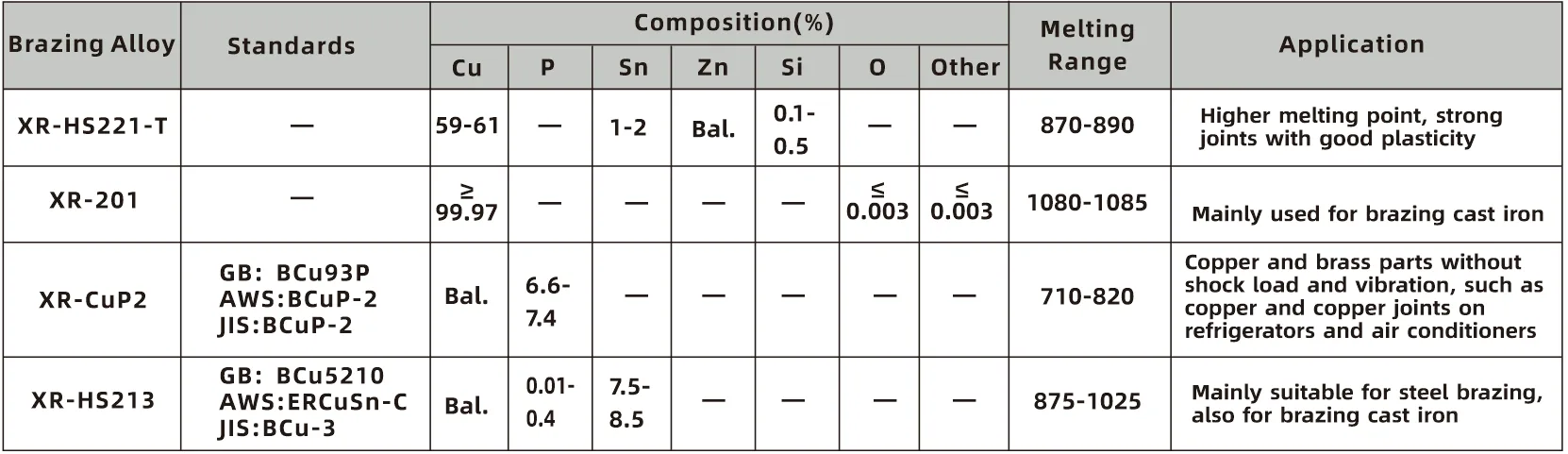
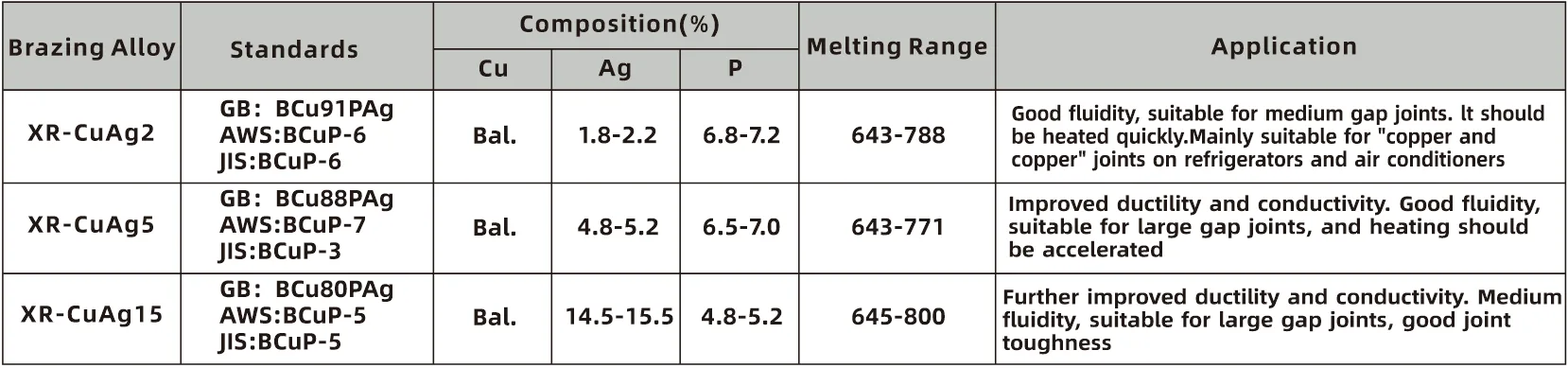
The following images are the existing catalog tables for phos-copper and phos-copper-silver alloys. Read the values on the image, then confirm them on a current datasheet before you place a trial order.
Copper-based filler metal is divided into four categories: high-copper alloy, copper-zinc alloy, copper-phosphorus alloy and special copper alloy.
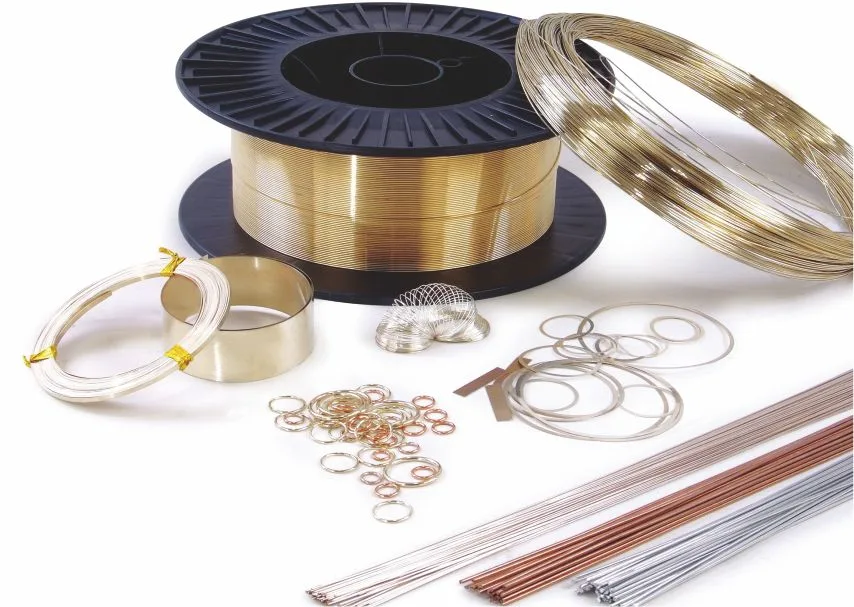
Copper-zinc alloy brazing filler metals are mainly used for gas flame brazing, high-frequency brazing and salt-bath immersion brazing of copper, copper alloy, nickel steel, cast iron, hard alloy and similar assemblies.
Copper-phosphorus filler metal is based on the Cu-P binary alloy and has good fluidity. It is used mainly for brazing copper and copper alloy. Because of the high phosphorus content, it cannot be used for brazing steel, nickel or their alloys. Adding silver to a copper-phosphorus alloy greatly improves wettability of the filler metal.

1. Phos-copper brazing alloys
2. Phos-copper-silver brazing alloys
Frequently asked questions
Can I use phosphorus-copper rod on a copper-to-steel joint?
No. Phosphorus-copper (BCuP-type) fillers should be kept for copper and copper-alloy joints. For copper-to-steel, a silver-based filler with a matching flux is the usual starting point. Ask for a written recommendation and a trial on the actual parts.
Do I still need flux on clean copper with a BCuP-type alloy?
On clean copper, phosphorus-copper fillers are often used without a separate flux because the phosphorus provides a self-fluxing action. Oxidized surfaces, brass, or poorly fitted joints may still need flux or a different cleaning method. Follow the datasheet.
How should I specify a grade?
Give the base metals, joint clearance, heating method, any pressure or leak-test requirement, and a preferred AWS A5.8 or ISO 17672 class if you have one. We can then match a catalog grade or discuss a custom size.