



Silver brazing filler metal is the most expensive filler on the shelf, and every buyer who picks it up asks the same question: is it worth it? The honest answer is that it is — sometimes. Silver earns its price on joints where nothing cheaper works well: copper to steel, copper to brass, stainless steel, and the refrigerant-tight joints in HVAC and refrigeration equipment. On a plain copper-to-copper joint, it is usually money spent for nothing. This guide is about telling those two cases apart, and about the one rule that is no longer negotiable: the silver filler you buy today should be cadmium-free. XINRUI’s silver-based filler metals do not contain cadmium, and that is now the baseline a buyer should expect from any supplier.
Why cadmium-free is the starting point, not a feature
Cadmium used to be added to silver brazing alloys because it lowered the melting range and helped the filler flow. The cost was paid by the people doing the brazing: cadmium oxide produced during brazing is highly toxic and carcinogenic, and cadmium-bearing fillers should not be used for long periods. That is why cadmium-free is now the default in the grades buyers actually purchase — BAg-5, BAg-7, BAg-24 and BAg-28, the cadmium-free classes of the BAg series in AWS A5.8/A5.8M and the Ag types in ISO 17672. XINRUI’s silver-based filler metal is cadmium-free, supplied as wire, rod and ring, with controlled wire diameter and chemical composition as stated in the catalog. If a supplier cannot confirm in writing that a silver filler is cadmium-free, that is a reason to stop the conversation, not a detail to check later. The same applies to the flux that goes with it: silver fillers are used with an active flux in air, and the flux classification for this role is AWS A5.31.
What silver filler actually does
A silver-based filler metal is a silver or silver-based solid-solution brazing alloy. It is used when the joint needs good wetting, a relatively low brazing temperature compared with many copper-zinc fillers, and a combination of strength, plasticity, electrical conductivity and corrosion resistance. That combination is what makes it the filler for dissimilar joints: it wets copper, brass, steel, stainless steel and nickel alloys, and combinations of those metals, where a cheaper filler would either not wet the joint or would leave a joint too weak for the service it is in. The catalog grades are straightforward about what you are buying. The table below is taken from XINRUI’s own catalog — the four workhorse grades, with their silver content and melting ranges:
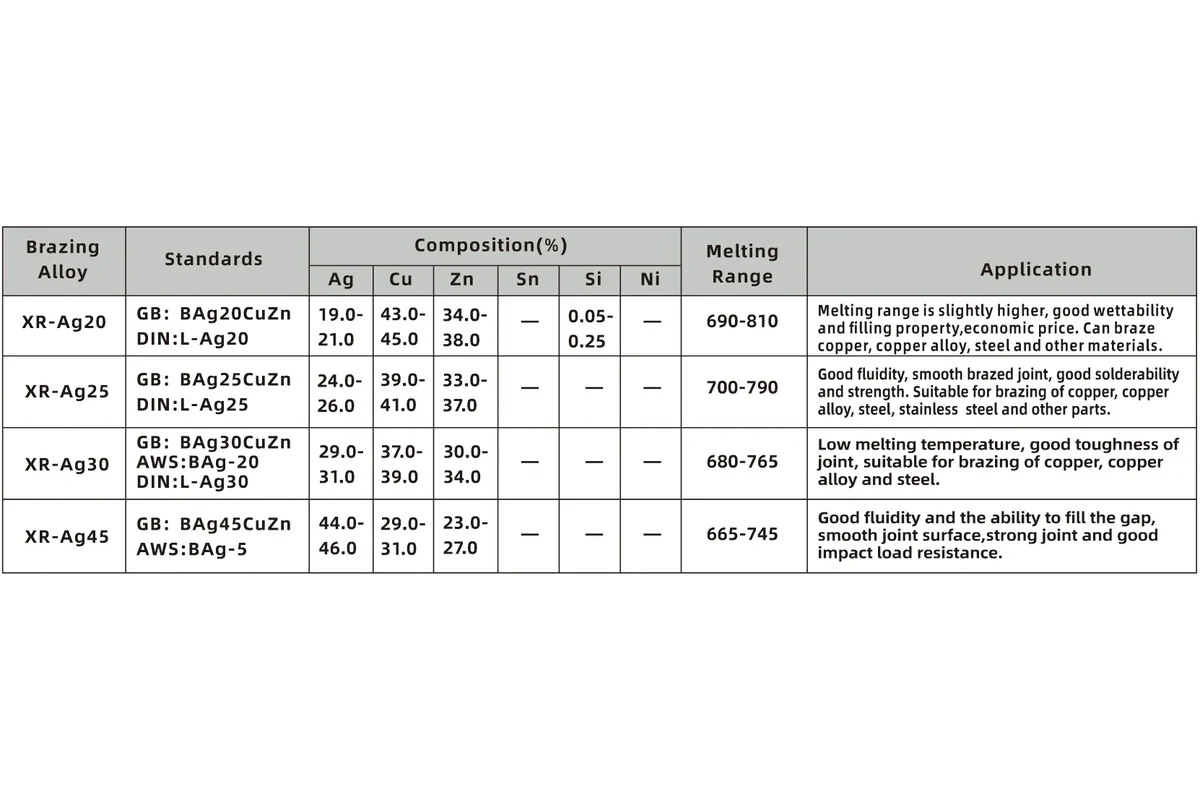
Read the table the way a buyer should. XR-Ag20 (GB BAg20CuZn, DIN L-Ag20) carries 19–21% silver and melts at 690–810 °C; it is the economical grade, with a slightly higher melting range and good wettability and filling, for copper, copper alloy and steel. XR-Ag25 (GB BAg25CuZn, DIN L-Ag25) carries 24–26% silver, melts at 700–790 °C, and is noted for good fluidity and a smooth joint. XR-Ag30 (GB BAg30CuZn, AWS BAg-20, DIN L-Ag30) carries 29–31% silver, melts at 680–765 °C, and is the low-melting, tough-joint grade for copper, copper alloy and steel. XR-Ag45 (GB BAg45CuZn, AWS BAg-5) carries 44–46% silver, melts at 665–745 °C, and is the high-fluidity grade with a smooth joint surface, strong joint and good impact load resistance. The catalog also lists tin- and nickel-containing silver alloys — XR-Ag25Sn, XR-Ag30Sn, XR-Ag34Sn and XR-Ag40Sn (AWS BAg-28), with melting ranges down to 630–730 °C, and XR-Ag50Ni (AWS BAg-24) with 1.5–2.5% nickel for stronger joints on steel and stainless steel. As a public example only, BAg-7 is often listed at about 56% silver with copper, zinc and tin, with a melting range of about 618–652 °C — that figure comes from the standard family, not from a named XINRUI SKU, and the grade you trial should always be chosen from its own datasheet, with the AWS or ISO designation on it. Where a catalog grade, diameter, packing or process window is not listed on the product page, it can be manufactured or selected to order — ask for the current datasheet for the grade you will trial.
Where silver still earns its place
The first place is HVAC and refrigeration. Typical uses in the catalog are copper-to-steel or copper-to-brass joints in HVAC and refrigeration, and valves and fittings in industrial manufacturing — joints that have to hold refrigerant for the life of the unit, where a leak found after charging is the most expensive kind of failure. Our HVAC and refrigeration application page covers the equipment these joints go into: central air conditioning, refrigeration and cold-chain systems, where the joint has to be leak-tight and corrosion resistant. The second place is any joint that mixes metals. Silver filler is for ferrous metals and non-ferrous metals — copper, brass, steel, stainless steel, nickel alloys and combinations of them. The third place is joints that see load or vibration, where the combination of strength, plasticity and toughness matters more than the filler price. If your joint is none of those things — a plain copper-to-copper joint on a fitting that never sees refrigerant, load or a second metal — silver is probably the wrong answer, and the next section says what to use instead.
Silver vs copper-phosphorus: the line between them
The cheaper filler most buyers compare silver against is copper-phosphorus — the BCuP family, including silver-bearing phosphorus-copper grades. The catalog shows phos-copper-silver alloys alongside the BAg grades, and the distinction matters: phos-copper-silver materials are for copper-to-copper work and must not be used on steel or nickel. They are not interchangeable with BAg alloys. The rule of thumb is simple. If the joint is copper to copper, and nothing else is involved, a phosphorus-copper filler — XINRUI’s copper-based filler metal range covers Cu-Zn, phosphorus-copper and silver-bearing phosphorus-copper, for flame, induction and furnace brazing — is the economical choice, and it needs no flux on clean copper-to-copper joints. The moment the joint involves steel, stainless steel or nickel, or the joint needs flux and the active wetting that silver gives, the BAg grade is the right one. Buying silver for a copper-to-copper joint is waste; buying phosphorus-copper for a copper-to-steel joint is a joint that will fail. Ask the supplier which side of that line your joint sits on, and get the answer tied to the grade, not to a price.
Flux, and the form the filler comes in
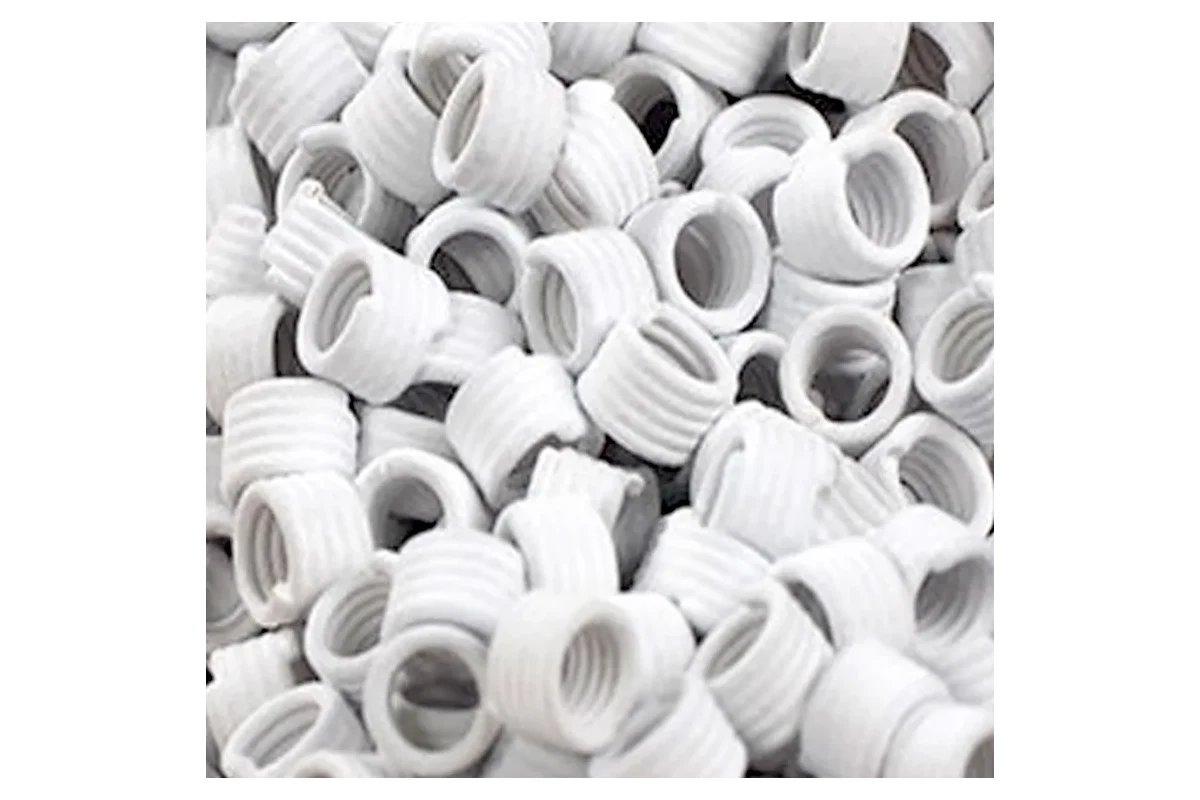
Silver filler in air needs an active flux — that is part of the system, not an accessory. XINRUI supplies a brazing flux paste for copper-silver alloy filler for this role, and where a joint has to be fluxed the same way every time, the flux can come already on the filler: the flux-coated brazing ring is a preformed ring with a flux coating, placed at the joint before heating, so the operator does not have to apply flux by hand. That is the form to look at when the volume is high and the joint repeats — the ring puts the same amount of filler and flux at the same place on every part, and the joint stops depending on the operator’s hand. Wire and rod suit repair work, small batches and joints where the operator controls the feed; rings suit production. Diameter, ring geometry and packing can be made to order, so send the joint drawing and let the form be sized from it. And one limit to respect: silver filler is not for aluminum or magnesium, or other low-melting-point metals. For those assemblies, use an aluminum filler and a matching flux — 4047 aluminum-silicon filler metal, about 11–13% silicon, AWS BAlSi-4 / ISO Al 112 — or the dedicated copper-to-aluminum flux-cored material, which our guide on copper to aluminum brazing covers in full.
What to check before you order
Silver is priced by the gram, so the order should be checked the way the metal is checked. Ask for the current datasheet for the grade you will trial, and check four things on it: the AWS A5.8 or ISO 17672 designation, so you know which BAg class you are buying; the composition, so the silver content matches the grade name; the melting range, so it suits the base metals and the heating method; and the written confirmation that the alloy is cadmium-free. Then trial it on your own parts, on your own line, with the flux you will actually use — a joint that looks good in a supplier’s demonstration can behave differently on your joint geometry and your heating cycle. XINRUI offers free samples, trial brazing, training and on-site support, with 24/7 technical support, and the company behind the filler is certified to IATF 16949, ISO 9001, ISO 14001 and ISO 45001, with RoHS-compliant full-process management. Our guide on how to choose a brazing materials factory covers the wider questions to ask any brazing supplier before a first order — filler, flux and form as separate items, and what to ask for in a first inquiry — and the the About page sets out the company’s history, certifications and bases. Send the joint, the base metals and the volume, and the grade can be recommended from those, rather than from a price list.
FAQ for refrigeration and HVAC manufacturers
Is XINRUI’s silver brazing filler metal cadmium-free?
Yes. XINRUI’s silver-based filler metals do not contain cadmium. Cadmium-bearing fillers should not be used for long periods, because the cadmium oxide produced in the brazing process is highly toxic and carcinogenic. Ask any supplier to confirm in writing that a silver filler is cadmium-free before you order.
When is silver filler worth the price?
Silver earns its price on joints where nothing cheaper works well: copper to steel, copper to brass, stainless steel, and the refrigerant-tight joints in HVAC and refrigeration equipment. On a plain copper-to-copper joint, it is usually money spent for nothing — a phosphorus-copper filler is the economical choice there.
Can I use silver filler on aluminum?
No. Silver filler is for ferrous metals and non-ferrous metals except aluminum, magnesium and other low-melting-point metals. For aluminum assemblies, use an aluminum filler and a matching flux — 4047 aluminum-silicon filler metal, about 11–13% silicon, AWS BAlSi-4 / ISO Al 112 — or the dedicated copper-to-aluminum flux-cored material.
What is the difference between a BAg grade and a phosphorus-copper filler?
BAg grades are silver brazing alloys classified in AWS A5.8/A5.8M and ISO 17672, used with an active flux on copper, brass, steel, stainless steel and nickel alloys. Phosphorus-copper fillers (the BCuP family, including silver-bearing phosphorus-copper grades) are for copper-to-copper work and must not be used on steel or nickel. They are not interchangeable.
What should I ask for before ordering silver filler?
The current datasheet for the grade you will trial, and check four things on it: the AWS A5.8 or ISO 17672 designation, the composition, the melting range, and written confirmation that the alloy is cadmium-free. Then trial it on your own parts, on your own line, with the flux you will actually use.
Silver is the filler you buy when the joint gives you no cheaper option — and the test is simple: if the joint is copper to steel, copper to brass, or stainless steel, or if it has to hold refrigerant for the life of the unit, silver is doing real work. If it is copper to copper, spend the money somewhere else. Either way, start from the joint and the datasheet, not from the price list, and trial the grade on your own parts before you order in volume. See the silver-based filler metal page for the catalog grades, or contact XINRUI to request a datasheet and samples for the grade you will trial.