




A flux-coated brazing ring combines a preformed filler-metal ring with a flux coating, so both are placed at the joint before heating. The catalog highlights high-frequency brazing and use in air conditioning, refrigeration, radiators and auto parts. Alloy, coating type and size are taken from the datasheet or made to order.
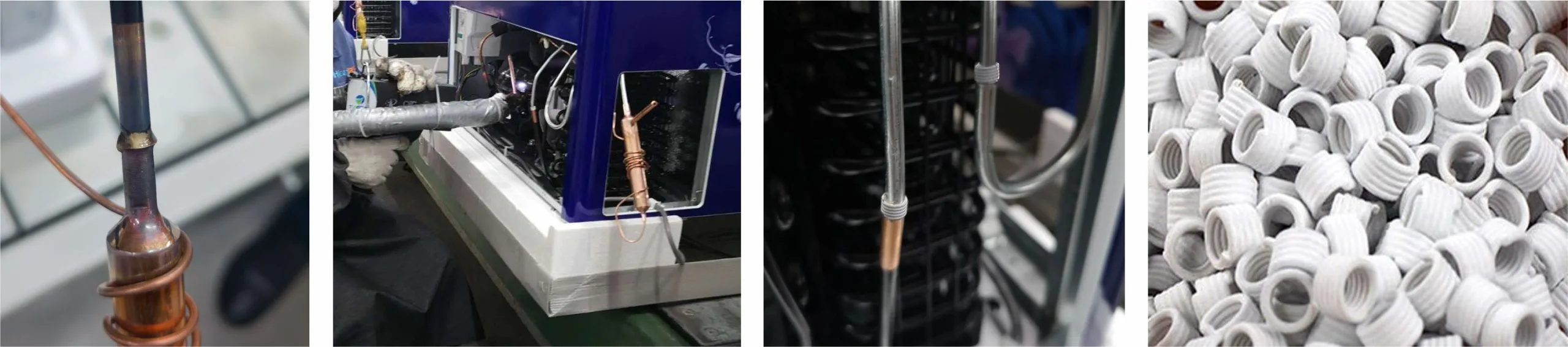
A flux-coated brazing ring is a self-contained preform: the filler metal is formed into a ring and coated with flux so that both materials are placed at the joint before heating. The existing catalog describes it as a way to combine efficiency, cleanliness, economy, automation and stable quality. It is suitable for various brazing processes and is especially used in high-frequency (induction) brazing. Typical industries already listed on this page are air conditioning and refrigeration, radiators, and auto parts.
Where a catalog grade, diameter, packing or process window is not listed on this page, it can be manufactured or selected to order. Please contact XINRUI and request the current datasheet for the grade you will trial.
How the form works
A preformed ring doses a measured amount of filler at the joint land or groove. The flux coating replaces a separate fluxing step when the coating chemistry matches the base metals and heating method. That combination is useful on automatic or semi-automatic lines, where a loose paste or a hand-fed rod would vary from part to part. The ring still has to match the tube diameter, land width and clearance; a wrong size will starve or flood the joint.
Standards and alloy families
The filler-metal core is classified, according to its composition, in AWS A5.8/A5.8M and ISO 17672. The flux coating, when it is a defined type, is discussed under AWS A5.31/A5.31M. This page does not name a single BAg, BCuP or Al-Si class for the standard ring. Silver-based and copper-phosphorus rings are common in HVAC and radiator work; aluminum rings would use a different flux chemistry. Tell us the base metals and we will quote a coated ring against a named grade, or make a custom size.
Base metals and process
The catalog highlights high-frequency brazing and use in air-conditioning, refrigeration, radiator and automotive parts. Heating may also be by flame or a fixture-mounted inductor, depending on the line. Joint design, coating type and post-braze residue rules must be confirmed on a trial. Related solid fillers are on the silver-based and copper-based pages; aluminum preforms are discussed with the 4047 aluminum-silicon family.
Forms and specifications
Rings are specified by inside diameter or tube size, wire section, and coating type. Dimensions not shown in the photograph can be made to order. Ask for packing, storage limits and a datasheet with the alloy composition and melting range.
Applications
Typical uses include tube-to-header and tube-to-fitting joints in HVAC and refrigeration, radiators and other heat exchangers, and automotive thermal parts.
The flux-coated brazing ring is a self-brazing material that combines flux and filler metal. It is characterized by high efficiency, cleanliness, economy, automation and stable quality. It is suitable for various brazing processes, especially high-frequency brazing, and is widely used in the air-conditioning and refrigeration industry, the radiator industry and the auto-parts industry.
Frequently asked questions
What alloy is the ring made from?
This page does not list a single standard designation. Flux-coated rings can be made from silver-based, copper-phosphorus or other filler families, depending on the joint. Ask for the alloy, coating type and AWS A5.8 or ISO 17672 class on the datasheet before you order.
Why use a coated ring instead of wire and a separate flux?
A preformed ring places a measured amount of filler at the joint. The flux coating supplies the flux with the preform, which helps repeatability in high-frequency (induction) and automated flame brazing, provided the ring matches the land or groove.
How should I store flux-coated rings?
Keep them dry and in the original packing until use. Coating adhesion and moisture pickup affect wetting. Storage and shelf-life limits should come from the datasheet.