



A copper-to-aluminum joint shows up in more places than most buyers expect: a copper tube brazed into an aluminum header on a heat exchanger, a copper conductor joined to an aluminum terminal in an electrical fitting, an aluminum part taking the place of copper in a wind-power assembly. It looks like an ordinary brazed joint, and that is exactly the trap. Reach for the filler already on the shelf — the aluminum-silicon wire you use for aluminum-to-aluminum work, or the phosphorus-copper rod you use for copper-to-copper — and the joint will usually fail, either on the bench or later in service. Copper-to-aluminum needs a system made for it, not a standard alloy pressed into service.
Why a standard alloy fails on copper to aluminum
The problem is the two oxides, not the two metals. Aluminum covers itself in a tough oxide the moment it meets air, and copper carries its own oxide layer. A filler can only wet a clean surface, so the flux has to strip both oxides at brazing temperature — and a filler made for one side of the joint carries no answer for the other. Our aluminum-silicon alloy filler metal 4047 (about 11–13% silicon, AWS BAlSi-4 / ISO Al 112) is made for aluminum-to-aluminum joints; on a copper surface it has no flux system that cleans copper oxide, so it will not wet the copper side properly. A phosphorus-copper filler has the opposite problem: our copper-based filler metal (the BCuP phosphorus-copper family) is self-fluxing on clean copper, but that self-fluxing action does nothing for aluminum oxide, so the aluminum side stays unwetted. A silver filler is no answer either — our silver-based filler metal is cadmium-free and made for ferrous and non-ferrous metals except aluminum, so it is the wrong family for a joint that has aluminum in it. In each case the joint may look filled and still be weak, because the filler never truly bonded to one side. That is why the catalog is blunt about it: a copper-to-aluminum joint is not a place to force a standard aluminum-silicon or copper-phosphorus alloy.
What a dedicated Cu-Al system looks like
A dedicated system puts the flux where the joint is, inside the filler itself. XINRUI’s brazing material for copper to aluminum is a flux-cored material: the outer layer is a Zn-Al alloy and the inner layer is a composite of white fluoride flux — high-purity cesium fluoride with very high activity. As the wire heats, that flux removes the oxide from the surface of the copper tube and the aluminum tube at the same time, so the Zn-Al filler can wet both sides and be drawn into the joint. The system is described as non-corrosive, so no cleaning is needed after brazing. It is made for flame brazing, high-frequency induction brazing and furnace brazing of copper to aluminum alloy, brass to aluminum alloy, and aluminum alloy to aluminum alloy — one system covering the transition joints a shop actually meets. The catalog shows two constructions, seamless and seamed flux-cored wire; which one to use is a question for the datasheet and for how the wire will be fed or preformed, not something to guess from the name.
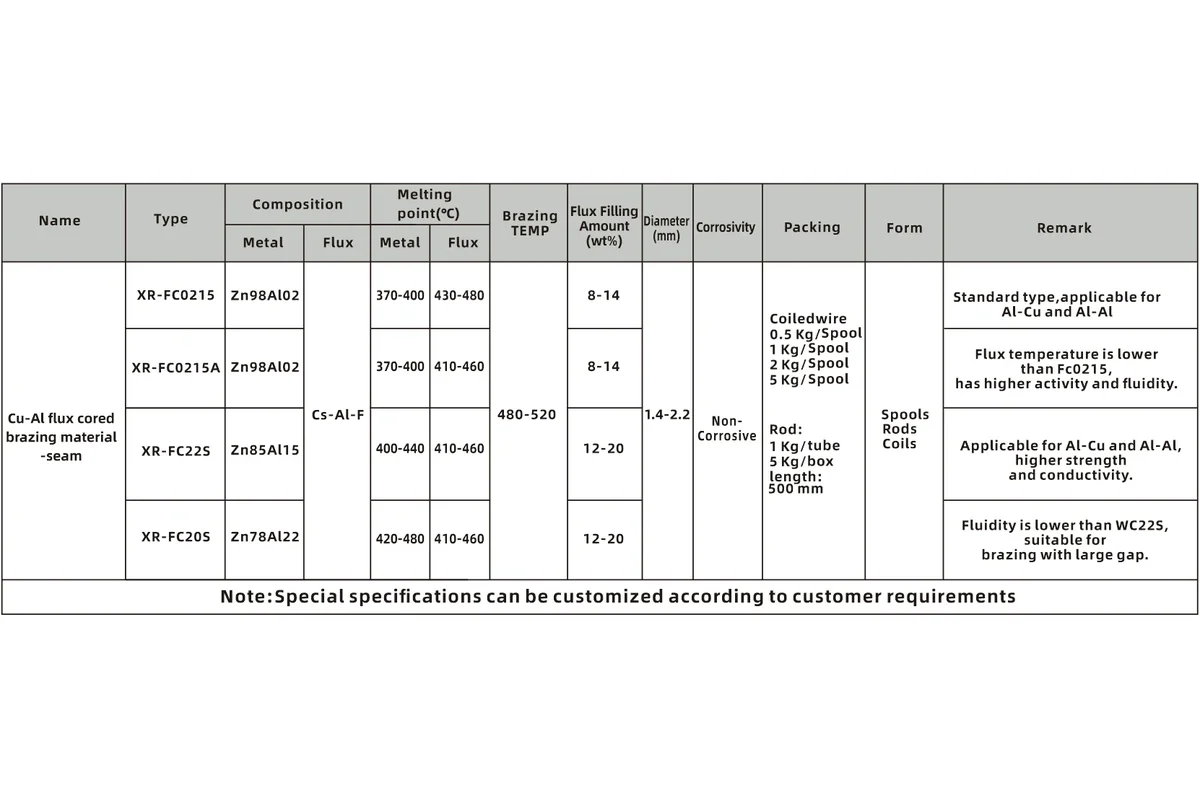
The grades: what the catalog actually lists
There is no substitution chart for copper-to-aluminum work — no honest one exists, because the right grade depends on the joint, the gap and the heating method, and it has to be confirmed by trial. What the catalog does list is a family of seamed grades to choose from, all with a Cs-Al-F flux core and all non-corrosive. XR-FC0215 (Zn98Al02) is the standard type, for Al-Cu and Al-Al, with the metal melting at 370–400 °C, the flux at 430–480 °C, a brazing temperature of 480–520 °C and a flux filling of 8–14 wt%, in diameters of 1.4–2.2 mm, supplied as spools, rods and coils. XR-FC0215A has a lower flux temperature than FC0215, with higher activity and fluidity. XR-FC22S (Zn85Al15) is the higher-strength, higher-conductivity grade, for Al-Cu and Al-Al, with the metal melting at 400–440 °C and a flux filling of 12–20 wt%. XR-FC20S (Zn78Al22) has lower fluidity than the 22S grade and suits brazing with a large gap. The seamless XR-WC series (WC0215, WC22S, WC20S) covers the same idea in seamless form, brazing at 450–520 °C, in diameters from 1.0 to 6.0 mm, supplied as spools, rods and rings. Treat those numbers as the starting point for a trial, not as a buying decision: send the supplier the base metals, the joint gap and the heating method, and let the datasheet and a trial joint settle the grade. Our aluminum flux-cored brazing material (XR-FC0315Z high-cesium and XR-FC0315K medium-cesium) is the parallel family for aluminum-to-aluminum work, and it shows the same idea — flux inside the wire, where the joint is — applied to a different pair of metals.
EF-11 wire and E11 paste for electrical fittings
Not every Cu-Al joint is a tube joint. For electrical fittings, XINRUI lists the EF-11 / E11 wire-and-paste system. EF-11 brazing wire is a silver-gray filamentous solder used with E11 brazing paste for flame brazing of aluminum alloys and copper alloys. The wire may be dipped in the paste, or the paste may be brushed on the workpiece, and then the joint is heated. No cleaning is required after brazing, and the operation is simple. The catalog figures: EF-11 melts at 370–420 °C, with a recommended brazing temperature of 480–530 °C; E11 flux paste is a white paste melting at 420–480 °C, with the same recommended brazing temperature of 480–530 °C, described as noncorrosive with no need for cleaning after brazing. A wire-and-paste system like this is a practical answer where a spool of flux-cored wire is the wrong form — small fittings, short runs, joints that are easier to brush than to feed.
Forms and preforms: wire, strip, rings, WPR
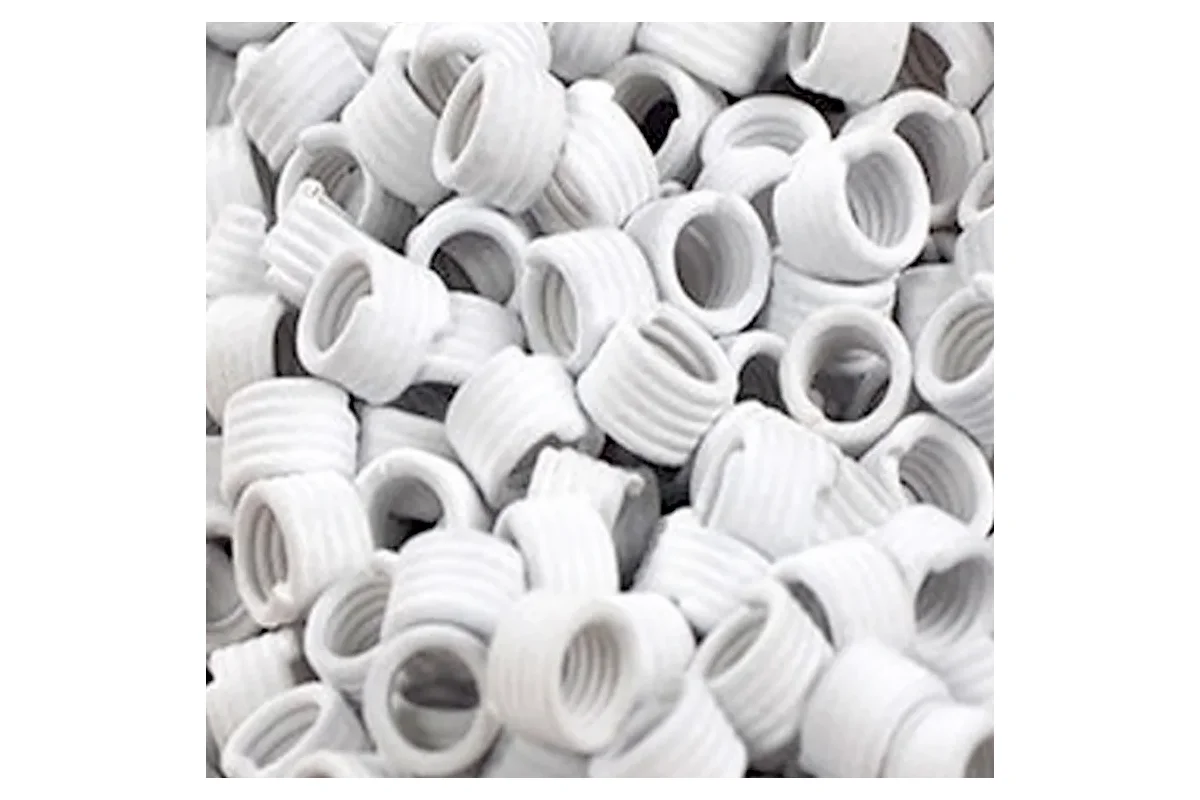
The same Cu-Al material comes in more forms than wire on a spool. The catalog describes reprocessing performance as good, and the filler can be made into preforms to various requirements: wire diameter can be as small as 1.0 mm, and strip (sheet) can be as thin as 0.02 mm, containing flux. That matters for two kinds of buyer. One is the shop that wants the filler already at the joint before heating — a ring or a strip placed in the joint, so the operator does not have to feed wire at the right moment. Our flux-coated brazing ring is the preformed-ring version of that idea: a ring with a flux coating, placed at the joint before heating, for repeat joints where the same filler in the same place every time is worth more than flexibility. The other is the wind-power buyer the catalog calls out: aluminum taking the place of copper, brazed as an alternative to argon-arc joining, for lightweight assemblies and to reduce the skill demanded of the operator. Wherever the joint repeats hundreds or thousands of times, the form of the filler is part of the decision, not an afterthought — ask the factory what forms a grade is supplied in, and what it can be preformed into.
Where the joints actually are
The typical uses the catalog lists are worth reading as a checklist of where to look for Cu-Al joints in your own products: copper-aluminum transitions in HVAC and refrigeration circuits, heat exchangers, electrical fittings, and wind-power or other energy components where aluminum replaces part of a copper conductor. In HVAC and refrigeration, the transition is usually copper tube to aluminum — a copper line meeting an aluminum coil or header — and it is a joint that has to stay leak-tight through pressure cycling and vibration, which is why a weak bond on one side is not a cosmetic problem. In electrical fittings, the joint has to carry current as well as hold together, which is why conductivity is one of the reasons the catalog distinguishes the FC22S grade. If you are already buying aluminum-silicon filler for your aluminum work and copper-phosphorus filler for your copper work, a Cu-Al transition is the joint where neither of those purchases helps — that is the moment to ask for a dedicated system instead of stretching one of the standard alloys.
What to confirm by trial before you order
Do not order a Cu-Al grade from a table alone. The catalog gives you the grades, the melting ranges and the forms; the trial gives you the answer. Before ordering, confirm these five things, on your own production parts rather than on coupons alone:
- The base metals and their temper. Tell the supplier exactly what copper or brass and what aluminum alloy you are joining. The flux has to clean both oxides, and the grade that suits one aluminum alloy may not suit another.
- The joint gap and the form. A large gap points toward a lower-fluidity grade such as FC20S; a tight, repeat joint may point toward a ring or a strip preform instead of wire. Send a joint drawing.
- The heating method. Flame, high-frequency induction and furnace brazing are all listed for the flux-cored Cu-Al system, but the grade and the form should match the way you actually heat the joint.
- The datasheet for the grade you will trial. Ask for the current datasheet — composition, melting range, flux filling, diameters, packing — and check it against the grade name on the order, because the catalog names (seamless, seamed, EF-11, E11, WPR) are the ordering names, not a standard designation. AWS A5.8 and ISO 17672 remain the reference documents for standard filler-metal classes; ask whether a given Cu-Al grade is supplied to a named designation or only to the catalog names shown here.
- What the trial joint shows. Braze your own parts, then check fill, appearance and leak-tightness — and, for electrical fittings, that the joint carries current as the design requires. XINRUI offers free samples, trial brazing, training and on-site support, with 24/7 technical support, and its about page lists the certifications behind it: IATF 16949, ISO 9001, ISO 14001 and ISO 45001, with RoHS-compliant full-process management. Our guide on how to choose a brazing materials factory covers the wider questions to ask any brazing supplier before a first order.
FAQ for electrical and HVAC manufacturers
Can I use 4047 filler for a copper-to-aluminum joint?
No. 4047 is an aluminum-silicon filler metal (about 11–13% silicon, AWS BAlSi-4 / ISO Al 112) made for aluminum-to-aluminum joints. On a copper surface it has no flux system that cleans copper oxide, so it will not wet the copper side properly. Use a dedicated copper-to-aluminum system instead.
What is inside a flux-cored Cu-Al wire?
The outer layer is a Zn-Al alloy and the inner layer is a composite of white fluoride flux — high-purity cesium fluoride with very high activity. As the wire heats, the flux removes the oxide from the copper tube and the aluminum tube at the same time, so the Zn-Al filler can wet both sides. The system is described as non-corrosive, so no cleaning is needed after brazing.
Does a copper-to-aluminum brazed joint need cleaning after brazing?
No. The flux-cored Cu-Al system is described as non-corrosive, so cleaning is not needed after brazing. The same applies to the EF-11 wire and E11 paste system, which is described as noncorrosive with no need for cleaning after brazing.
What are EF-11 wire and E11 paste for?
Electrical fittings. EF-11 is a silver-gray filamentous brazing wire used with E11 white brazing paste for flame brazing of aluminum alloys and copper alloys. EF-11 melts at 370–420 °C and E11 paste at 420–480 °C, both with a recommended brazing temperature of 480–530 °C. The wire may be dipped in the paste, or the paste brushed on the workpiece, and then the joint is heated.
How do I choose between the Cu-Al grades, such as XR-FC0215, FC22S and FC20S?
From the datasheet and a trial on your own parts, not from a substitution chart. XR-FC0215 is the standard type for Al-Cu and Al-Al; XR-FC22S is the higher-strength, higher-conductivity grade; XR-FC20S has lower fluidity and suits brazing with a large gap. Send the supplier the base metals, the joint gap and the heating method, and confirm the grade on a trial joint.
A copper-to-aluminum joint fails when a standard alloy is asked to do a job it was never made for — cleaning an oxide it was not designed to clean, on a metal it was not designed to wet. A dedicated system does the one thing the standard alloys cannot: it carries the flux to both sides of the joint, inside the filler. If you send XINRUI the base metals, a joint drawing and the heating method, the factory can recommend a grade and a form — wire, strip, ring or paste — and supply samples to trial on your own parts. See the brazing material for copper to aluminum page, or contact XINRUI to start a trial.